



How can you prevent roof tiles from staining and turning green with algae?

We recommend two practical approaches – for concrete roof tiles and for unglazed fired clay tiles.
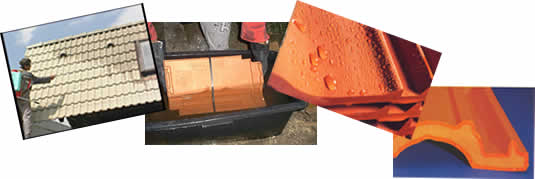
A) Existing roof: clean, dry, impregnate
- Cleaning: wash the roof with a pressure washer.
- If algae or moss is present: use MOSS and ALGAE REMOVER to support the cleaning.
- Drying: after cleaning, allow the roof to dry completely.
- Impregnation: apply silicone impregnation in two coats, wet-on-wet (apply the second coat before the first dries).
Recommended products:
- ROOF TILE IMPREGNATOR – ROOFTOP TILE (for unglazed fired clay roof tiles)
- CONCRETE ROOF TILE IMPREGNATOR – ROOFTOP CONCRETE ROOF (for natural concrete roof tiles)
Spraying tips
- Use a backpack sprayer, but avoid fine atomisation.
- Apply in larger droplets (spray–wet), for a more even, low-loss application.
- Work top-to-bottom and avoid windy or rainy conditions.
B) New roof: dipping before installation
For a new roof, the method is simpler and often more effective: treat the tiles by dipping before installation. A soak of about 90–120 seconds is usually sufficient. After draining and drying, the treated tiles can be installed.
Why does impregnation help?
Tiles differ in porosity, which affects how much water they absorb. When tiles stay wet, they bind dust and dirt more easily, algae and moss can settle, and in winter the material can deteriorate due to freeze–thaw. Silicone impregnation reduces water ingress so these moisture-driven problems are less likely to occur.
Video
See the practical effect in our video:
In the video you can see how silicone impregnation changes the behaviour of roof tiles. On an untreated tile, water is absorbed and the surface darkens, which encourages staining and biological growth. After impregnation, water beads up and runs off instead of soaking in. A drier tile stays cleaner, algae has a harder time establishing, and freeze–thaw damage is reduced.
- impregnating on a damp surface → patchy look, weaker performance
- only one coat → shorter protection
- too fine atomisation → material loss, uneven coverage
- using the wrong product for the tile type → uncertain result
- working in rain or strong wind → poor penetration and streaking
Here you can quickly access the most important pages and shortcuts.