



How to apply silicone water repellent (hydrophobic impregnation)
A reliable, practical method – what is allowed and what is not.

How should silicone impregnation (hydrophobisation) be applied?
A reliable, practical method
Hydrophobisation is easy — if you follow the technology.
In most cases you do not need specialist qualifications, but the technology must be followed strictly (and enforced if someone else performs the work).
I will show several application methods. Which one you should use depends on the job and the surface.
Options:
- Small areas:Small areas (brush / disc brush),
teddy roller- Brush / disc brush. A paint roller sleeve (“teddy roller”) is not allowed — based on our experience, complaints are linked to this method. A roller cannot work the material evenly into the surface; it tends to cause uneven protection. If there are joints, treat them with a brush.
- Large areas:Large areas (backpack or machine sprayer)
- Backpack sprayer or machine sprayer — use coarse droplets.

When applying with a sprayer, make sure it does not atomise the product; it must deliver coarse droplets. Atomising is not allowed because the fine mist can drift away and cannot properly saturate the surface capillaries.
When using a solvent‑based product, remember that it is flammable.
- It requires no special skills or “courage” — you only need a timer to measure the dipping time (about 1.5–2 minutes).
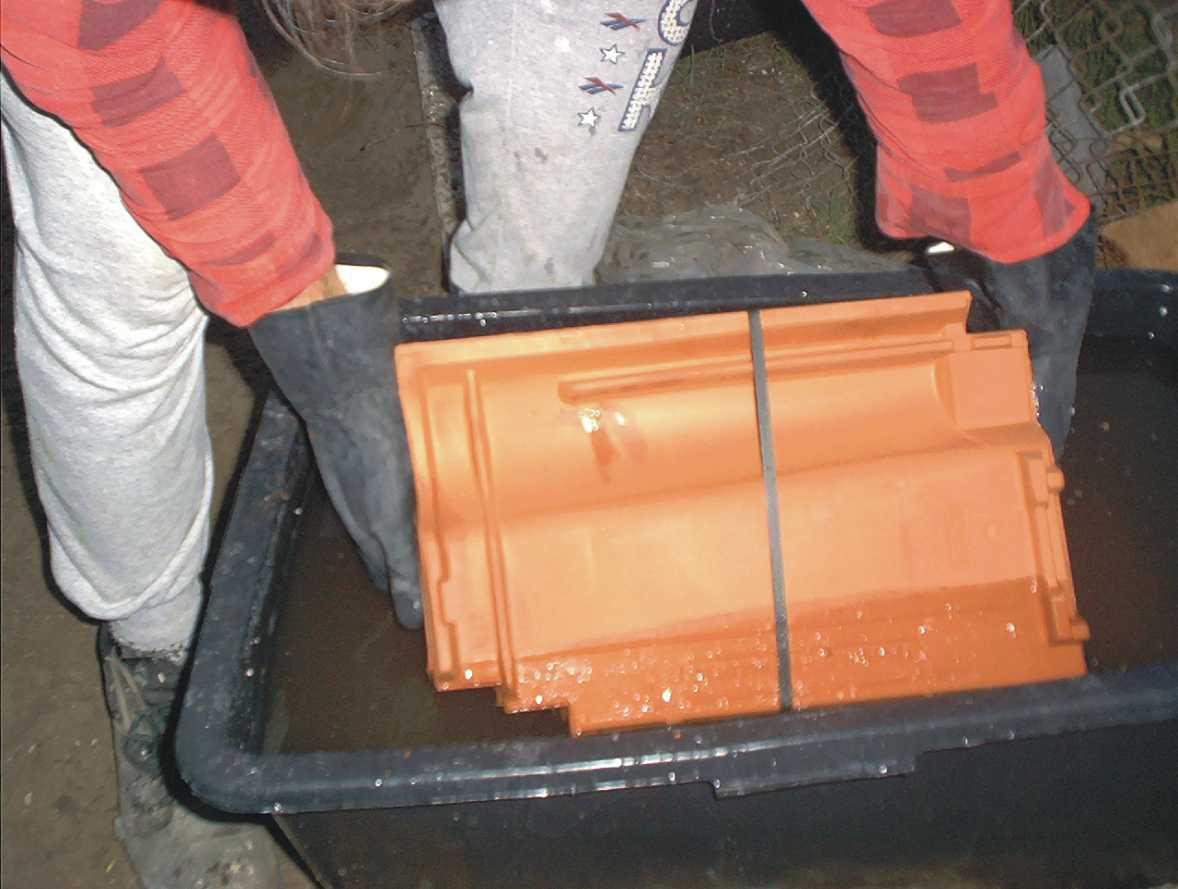
Now we know which method to use, but not yet how to do it correctly.
The correct approach is called the “wet‑on‑wet” method.
The essence is this: in all cases (except dipping), you apply the silicone product in two coats.
Keep applying the first coat to a given area until it is fully saturated and will not absorb any more.
Once you reach this point, move to the next untreated area and proceed the same way.
Always apply the second coat before the first one fully dries. If you let it dry completely and it runs again, you can forget about the next treatment for decades.
With this method you ensure that a near‑uniform amount of active substance reaches almost the entire penetration depth.

If the product does not absorb, remove the excess with a cloth or absorbent material; otherwise the surface may become patchy or sticky.
Effect of a successful treatment:
Half‑impregnated sand‑lime brick
Attention: Application temperature: 10-30 oC.Before treating painted surfaces, test whether the product dissolves the paint used.
If the surface has been treated with something before, the result may differ from what you expect.
With the above in mind, you can confidently head to the “battlefield” and win the fight against water.
Good luck!
_________________________________________________________________________________
Solvent‑based products are flammable.
- Using a “teddy roller” → uneven application, patching
- Atomising → inhalation risk + weaker saturation
- Only one coat → shorter‑lasting protection
- Second coat applied too late → not wet‑on‑wet
- Excess left on the surface → stickiness / patching
Here you can find the most important menu items and quick links: