CONCRETE CRÈME
Solvent-free, creamy water repellent

EN 1504-2:2004
CHARACTERISTICS:
CONCRETE CRÈME is a water-based, solvent-free, creamy, silane-based water repellent. A high-quality special product for the hydrophobic impregnation of both normal and reinforced concrete.
The treated concrete has the following permanent properties:
APPLICATION:
CONCRETE CRÈME is a unique impregnation agent because it is thixotropic. It has an outstanding ability to impregnate high-quality concrete and reinforced concrete.
Unlike traditional liquid products, CONCRETE CRÈME can be applied in only one layer of the desired thickness (maximum two layers). The silane active ingredient penetrates the substrate in 30 minutes or more hours, the exact time depends on the porosity and thus the quality of the concrete.
When reacting with the surface, it releases ethanol and turns into a polymer silicone resin. Initially, a creamy layer is formed, but this then disappears completely. Since the active ingredient is the same as traditional liquid impregnation agents, impregnation with CONCRETE CRÈME does not clog pores or capillaries, and does not affect its breathability.
CONCRETE CRÈME is designed to penetrate deep into the concrete to provide optimal protection against water and contaminants absorption and freeze/thaw cycles. This effect should not be confused with the "beading" effect caused by impregnating agents, often referred to as water repellents.
Beading is only a surface effect and plays a secondary role in protecting the substrate. Concrete treated with CONCRETE CRÈME initially has only a moderate beading effect, but this increases after wetting the surface.
STORAGE:CONCRETE CRÈME can be stored in its original, closed container at temperatures between 0 and 30 oC for at least 24 months from the date indicated on the label. However, experience has shown that it can be stored for up to 3 years without deterioration in quality.
Storage beyond the date indicated on the label does not necessarily mean that the product is no longer usable. However, in this case, for quality assurance reasons, the properties necessary for intended use must be checked.
.USE:
Surface preparation:
Before applying the impregnation agent, the surface to be treated must be cleaned of dirt and harmful substance deposits, salt efflorescence, and greenish discoloration caused by algae and moss.
Cleaning opens the openings of the capillaries and pores, thus enabling the perfect absorption of the impregnation agent, and can also prevent the impregnated dirty, contaminated surface from being impossible to clean, or only very difficult to clean.
New, not yet contaminated surfaces must be cleaned of coarse particles and dust deposits by sweeping or, if necessary, with compressed air.
Aged surfaces, as well as surfaces heavily contaminated with oil, rubber residue, etc., must be cleaned with superheated steam or high-pressure water before starting the treatment.
It is absolutely recommended to immediately vacuum and drain the water so that the concrete does not become too wet.
Execution:
The construction (preparation of the concrete surface, creation of a reference area, application and quality control) must be carried out in accordance with the relevant regulations!
Concrete must not be impregnated for at least four weeks after its production, so as not to affect the setting of the cement.
Impregnation must always be carried out on visually dry concrete, i.e. when the concrete surface appears uniformly dry, no moisture spots are visible and the moisture content has been balanced. To this end, the moisture in the surface zone of the concrete is measured using an appropriate technique (e.g. CM method). The water content of the surface zone of the concrete (up to a depth of 20 mm from the surface) must not exceed 4% by weight.
Apply CONCRETE CRÈME to the concrete using an airless technique, undiluted and to the desired thickness. For smaller areas, brushes, sheepskin rollers or spatulas can be used.
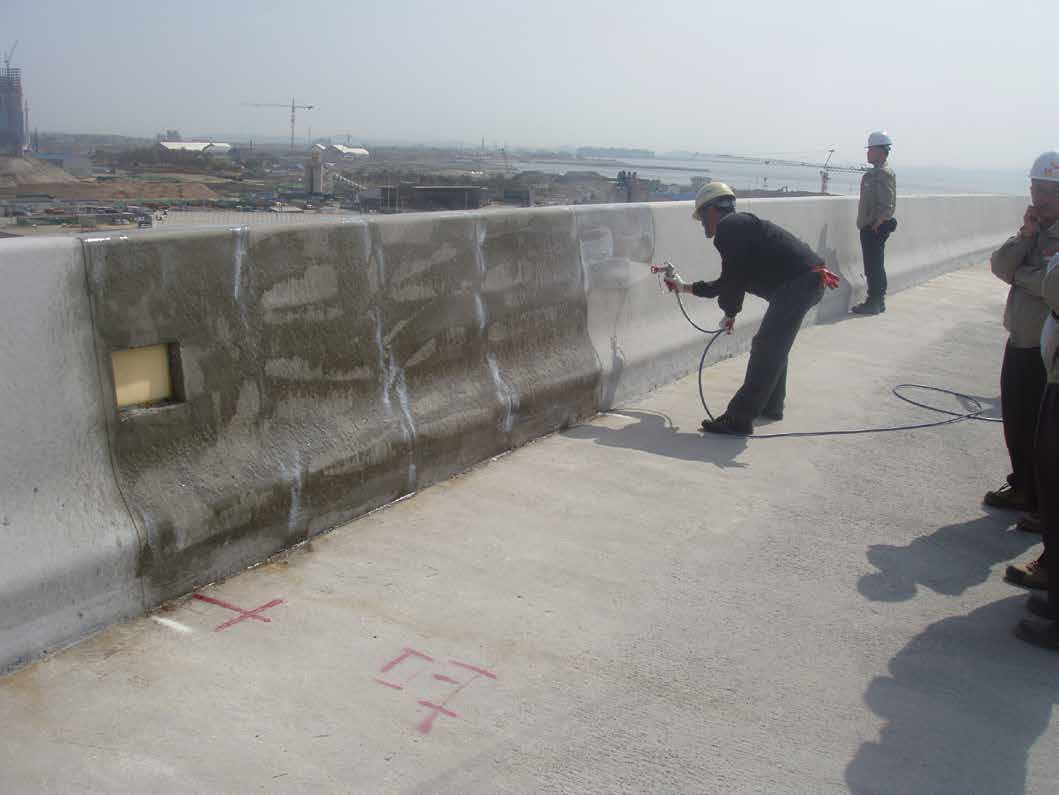
Up to 400 g/m² can be applied in a single application to vertical surfaces and ceilings without loss of material. The exact amount depends on the absorbency of the substrate.
Even higher application rates increase the risk of an impregnating film forming on the concrete surface, causing the product to run off. A second coat of CONCRETE CRÈME can be applied at any time, but is generally unnecessary. CONCRETE CRÈME can be applied with a sheepskin roller for better distribution.
In the event of unexpected rain, cover already impregnated surfaces and stop all further impregnation.
Do not allow CONCRETE CRÈME to come into direct contact with bitumen. The resistance of the insulation to CONCRETE CRÈME must be determined in relation to the temperature.
Attention: The surface to be treated must not be overheated!
Application temperature: 10-30 oC.
Below 10 oC, the chemical reaction slows down, so the development of the protective effect can take 1-2 weeks!
Safety measures:
The "Safety Data Sheet" can be obtained from the manufacturer or the dealer.
Safety Data Sheet reach
|
|